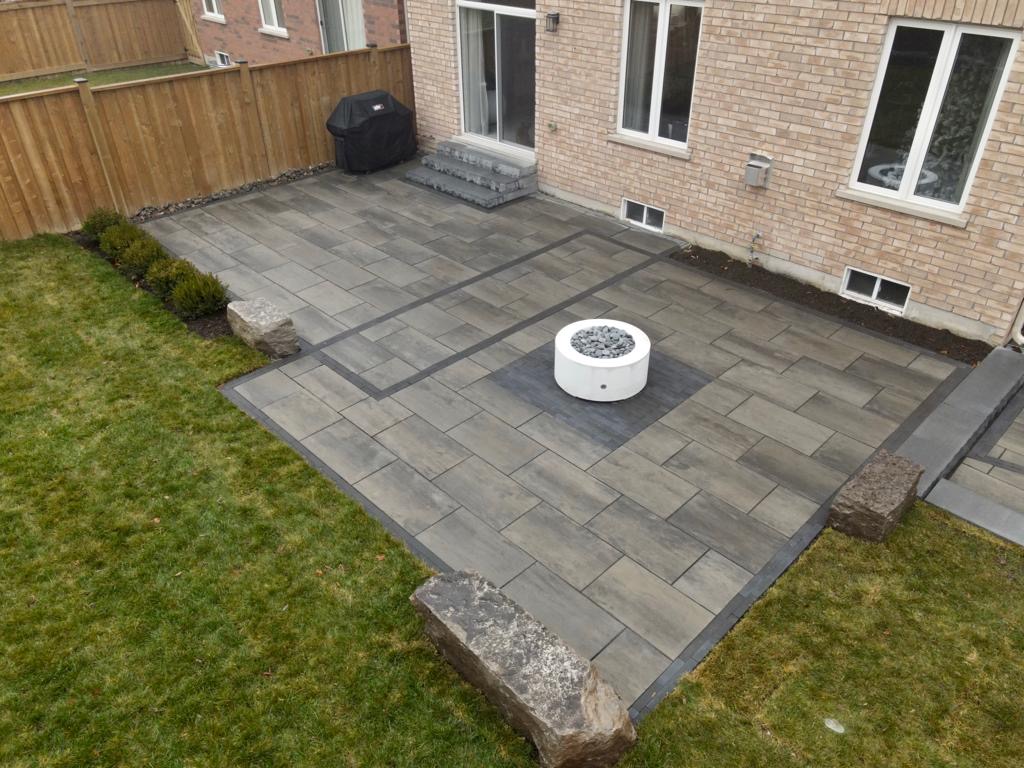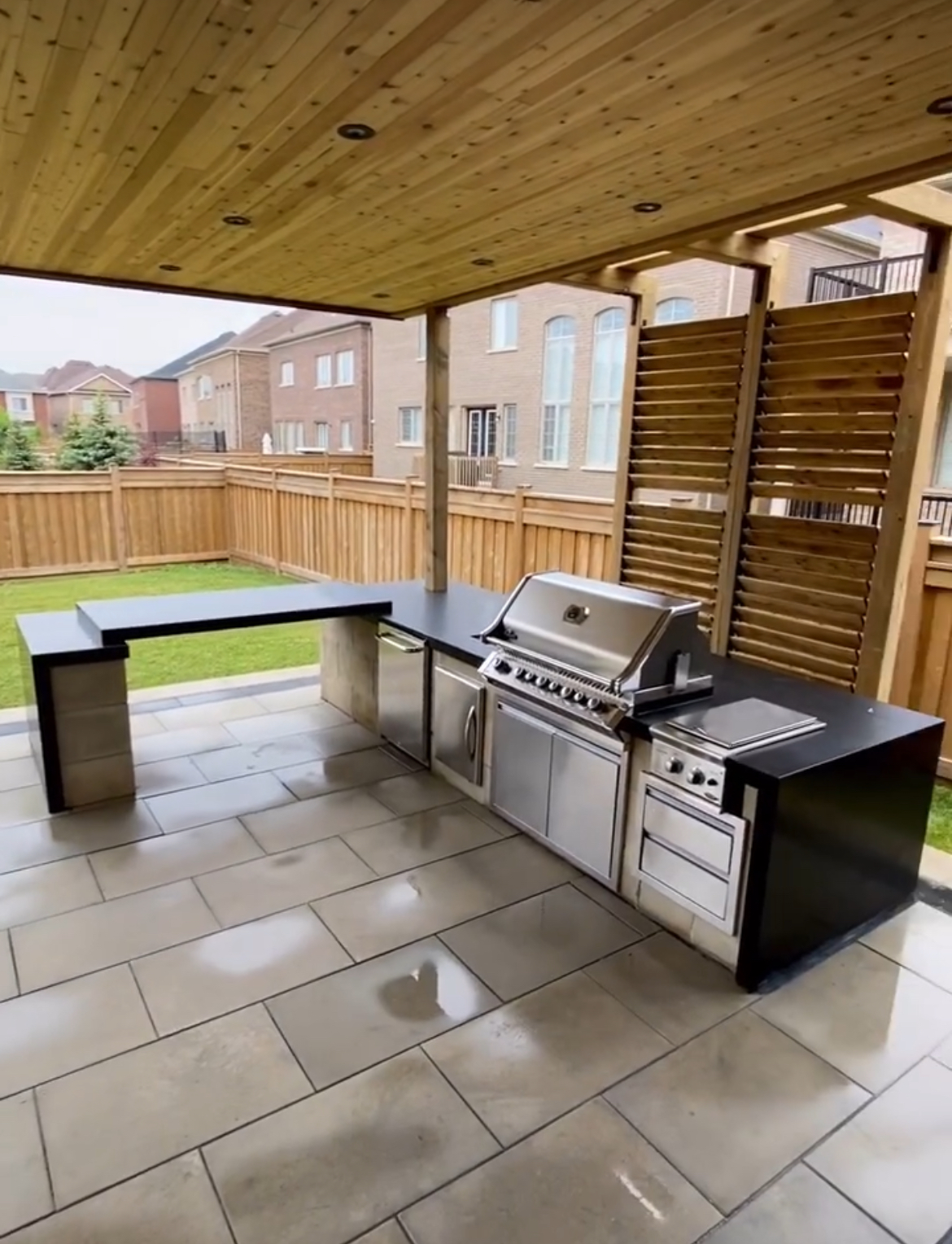
When most people picture a new interlocking driveway or patio, they think about the pavers — the colour, the pattern, the finished look. And those choices matter. But here’s what fifteen-plus years of building hardscapes across Richmond Hill and the GTA has taught us: the part you never see is the part that decides whether your project still looks perfect a decade from now. That part is the base.
Get the base right and your interlocking stays flat, tight, and level through winter after winter. Get it wrong and no paver on earth will save it — you’ll be looking at heaving, sinking, and shifting within a couple of seasons. So let’s talk about what a proper base actually is, and why the way we build ours is designed specifically for Canadian weather.
Why the base matters more than the pavers
Interlocking pavers aren’t glued down or poured in place. They’re a flexible surface that sits on layers of compacted aggregate. That flexibility is a strength — it lets the surface move slightly with the ground instead of cracking like a solid concrete slab. But it also means the pavers are only ever as good as what’s underneath them. The base carries the weight, spreads the load, and — most importantly in our climate — manages water.
And water is the whole game here. Because in Ontario, water doesn’t just sit there. It freezes.
The old way: a dense-graded base
For decades, the standard approach was a “dense-graded” base — crushed stone like Granular A that includes a lot of fine material, or stone dust. When you compact it, those fines pack in tight and lock together into a hard, solid layer. It’s strong, and for a long time it was simply how everyone did it.
The problem is those same fines that make it pack tight also make it hold water — especially over the heavy clay soil we have across much of the GTA. A dense-graded base can act like a sponge, trapping moisture underneath your driveway or patio. In summer that’s a nuisance. In an Ontario winter, it’s the beginning of the end.
The better way: an open-graded base
An open-graded base flips the approach. Instead of stone packed with fines, it uses clean, angular “clear” stone with the dust washed out. Because there’s no fine material filling the gaps, the base is roughly 40% open space — a network of voids that lets water flow straight through instead of pooling underneath.
That single difference is why an open-graded base holds up so well through our freeze-thaw cycles. It drains, it stays stable, and it doesn’t trap the water that causes so many problems come January.
How we build it
A proper open-graded system isn’t just one layer of stone — it’s built up in stages, each doing a job:
- A non-woven geotextile fabric laid over the soil first. This separates the clay below from the clean stone above, so the two never mix and the base stays clean and free-draining for the long haul.
- A clear-stone base — angular ¾” clean stone (No. 57) built up to the right depth for the job, and compacted carefully in lifts. Because there are no fines to crush out, an open-graded base barely loses any thickness during compaction, so what we build is what stays.
- A bedding layer of finer clear stone (No. 8, often called High Performance Bedding) that the pavers set into — screeded smooth and locked in so it won’t wash away.
For a driveway that carries vehicle weight, we build deeper and add a heavier clear-stone sub-base beneath all of that, plus solid edge restraint so nothing spreads over time. The principle stays the same — free-draining, frost-resistant, built to last — but the depth and detail scale up to the load.
Why this is the difference in a Canadian winter
Here’s the mechanism that ruins so many driveways and patios. Water gets trapped in a base that can’t drain. Temperatures drop, that trapped water freezes, and as it turns to ice it expands — with enormous force. That expansion pushes upward on everything above it. The result is frost heave: pavers that lift, tilt, and shift, joints that open up, and a surface that never sits quite level again. Then it thaws, drops, and does it all over again next winter.
An open-graded base breaks that cycle at the source. If the water drains away instead of sitting there, there’s nothing underneath to freeze and expand. No trapped water, no frost heave. That’s the entire reason we’ve made open-graded base our standard for the GTA — it’s engineered for exactly the winters we get.
What to ask before you hire anyone
Base work is invisible once the job is done, which unfortunately makes it the easiest place for a contractor to cut corners. Before you sign with anyone, ask them a few simple questions: What kind of base do you use — dense-graded or open-graded? Do you lay geotextile fabric over the soil? How deep do you build for a driveway versus a patio? How do you handle drainage on clay?
A contractor who knows our climate will have clear, confident answers. One who mumbles about “just crushed stone” is telling you something too.
Built for our winters, from the ground up
Beautiful pavers on a poor base will disappoint you within a few years. A properly built open-graded base is the quiet reason a King Kongtracting driveway or patio still looks and sits right long after the trucks have left. It’s the part you’ll never see — and exactly the part we obsess over.
Thinking about a new interlocking driveway, walkway, or patio in Richmond Hill or across the GTA? Reach out for a free, no-pressure quote and we’ll walk you through exactly how we’d build yours to stand up to whatever winter throws at it.